iPhone 17 Pro glass replacement: why glass-only repair is harder
Written by Pavel MaksymenkoLast updated: 9 August 2026Reading time: 10 min

A crack in the glass of an iPhone 17 Pro does not automatically mean the entire screen is beyond repair. If the image and touch function still work correctly across the full display, glass-only repair may preserve the original OLED panel. Only the damaged front glass is replaced, rather than the complete display module.
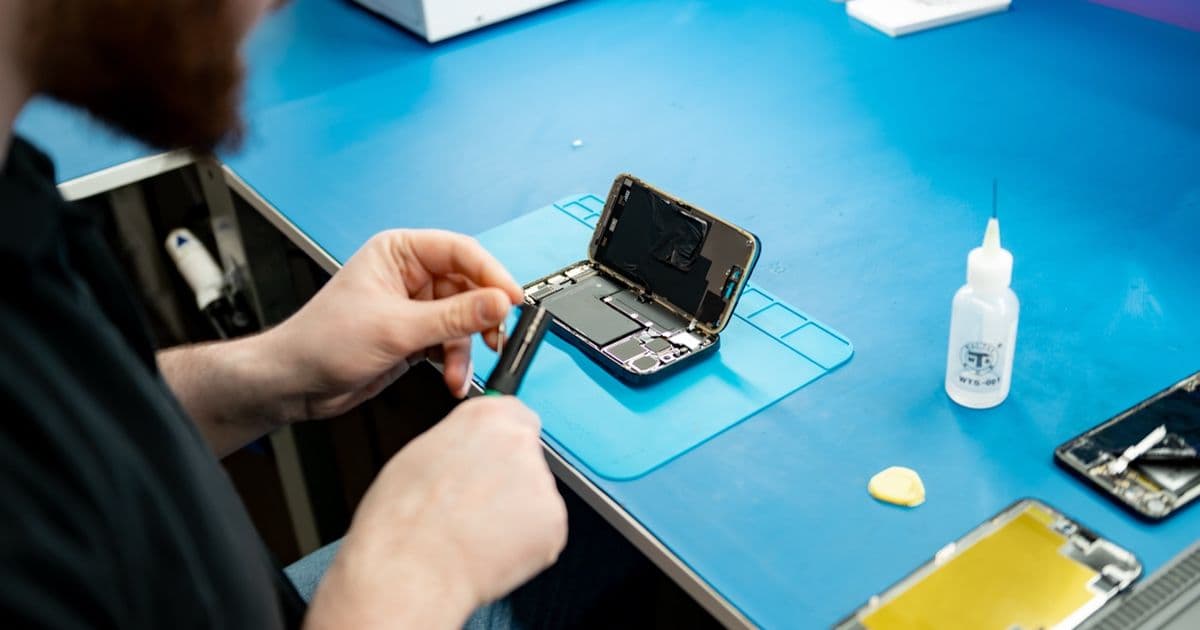
However, this repair is less straightforward on the iPhone 17 Pro than on earlier models. In a practical test by REWA Technology, the first OLED panel was damaged during separation. A second panel remained intact after the process was adjusted. The video therefore shows both the potential of this repair and its genuine technical risks.
The short answer: glass-only repair may be technically possible, but only after a careful assessment of the original screen and with a process adapted to this specific model. If only the front glass of your iPhone is cracked, you can explore the options for iPhone 17 Pro glass replacement.
What does glass-only repair mean for an iPhone 17 Pro?
The screen consists of several layers. The front glass sits on top, with an optically clear adhesive layer, the touch layer and the OLED panel that produces the image underneath. During glass-only repair, the broken glass and old adhesive are removed. The original OLED, touch layer and associated electronics are retained when they are still technically sound.
This differs from a complete screen replacement. A full replacement involves changing the entire display module. With glass-only repair, the existing module is refurbished in a specialised workshop, realigned and laminated again.
The potential advantage is clear: the original panel is retained, along with its original image characteristics. That benefit only applies if the OLED is healthy before the repair and the separation and lamination process causes no internal damage. The replacement front glass and adhesive layer are also not automatically identical to Apple’s original Ceramic Shield 2 construction.
What did REWA’s screen test show?
In October 2025, REWA published a video examining two iPhone 17 Pro screens. This was a test conducted by a parts supplier and repair laboratory, not an official Apple procedure or a broad independent study. That makes both the details and the limitations important.
1. Image and touch were tested first
Before disassembly, the team checked that the display and touch function worked correctly. This is an essential first step: lines, black spots, flickering or poorly responding areas may indicate damage beyond the front glass.
The display module was then removed, and the cameras and sensors were protected. REWA used a UV laser to treat the adhesive and release the edge of the screen. Because a dedicated laser diagram for the iPhone 17 Pro was not yet available at the time, the team initially used an iPhone 16 Pro diagram. This makes the video an early process test rather than an established standard procedure.
2. The OCA layer offered more resistance
OCA stands for optically clear adhesive: the transparent adhesive layer between the glass and the display layers. In REWA’s test, the iPhone 17 Pro glass was harder to separate than the glass on an iPhone 16 Pro tested with the same approach. The researchers therefore suspected that the OCA behaved differently or had a stronger bond.
Apple does not disclose the composition of this adhesive layer in the documentation reviewed. The accurate conclusion is that the OCA behaved differently in this particular test, not that Apple has officially confirmed a new chemical formula.
3. The first attempt damaged the OLED
On the first screen, REWA inserted a thin separation film between the glass and the display. Because of the resistance, the film did not move through the layer smoothly. According to the video’s analysis, the material bent under uneven force and damaged the OLED. A black spot appeared next to Dynamic Island during the final test.
This detail is instructive: a screen may still appear functional during an intermediate check, with visible damage only becoming apparent later. Testing is therefore required before disassembly, during the refurbishment process and after full lamination.
4. The second separation went better
For the second iPhone 17 Pro screen, REWA used only cutting wire for the separation. In the test shown, the panel remained intact after the glass was removed. One successful repeat does not prove that cutting wire is risk-free in every situation. It does show that the process needed to be adapted to the behaviour of this screen.
The video does not show a fully completed customer repair using the second screen. At the time of recording, the laboratory did not yet have a suitable aftermarket screen frame, and the team intended to optimise the laser settings further. The result is therefore most useful as a technical warning: an iPhone 17 Pro should not automatically be treated like an iPhone 16 Pro.
Why this repair leaves so little room for error
During glass-only repair, technicians work directly above a delicate OLED panel. Greater resistance in the adhesive layer increases the mechanical stress during separation. A small deviation in pressure, angle or tool position can cause a black spot, a line or complete loss of image.
A second critical stage follows. The old OCA must be removed without damaging the panel. The surface must remain free of dust, the new glass must be aligned precisely around Dynamic Island and along the edges, and the layers must be laminated evenly. Dust, trapped air or slight misalignment may remain visible in the finished result.
This is not a suitable do-it-yourself repair. The video shows specialised separation, dust-control and lamination equipment, along with several functional tests. The correct settings also depend on the individual screen, materials and equipment used.
What the video does not prove
A convincing demonstration can easily be interpreted more broadly than the test allows. The video does not establish that:
- Apple deliberately changed the OCA to make independent repair more difficult;
- every iPhone 17 Pro screen behaves in exactly the same way;
- cutting wire is always safe or a separation film always causes damage;
- replacement front glass has the same Ceramic Shield 2 properties and coating;
- the factory seal or original IP rating is fully restored after refurbishment.
Apple states that an iPhone’s water and dust resistance is not permanent and may decrease with normal wear. Disassembly is another reason not to assume absolute water resistance, even when a new seal is fitted.
Apple repair and glass-only repair are different routes
Apple’s public repair manual for the iPhone 17 Pro describes a display procedure focused on removing and replacing the complete display module, using new display adhesive, pressing equipment, diagnostics and post-repair completion. Apple does not describe separating the front glass from the OLED within the module.
Glass-only repair is therefore a specialised refurbishment route outside Apple’s published module-replacement procedure. Because the original display module is retained, the goal is different: preserving a healthy original OLED rather than replacing the entire screen.
If the complete module does need to be replaced, part quality matters. Apple warns that a non-genuine display may cause differences in touch response, brightness, colour, True Tone and power consumption. For a full replacement, FIXNOW recommends an original display. A compatible screen costs less, but its quality does not match the original.
Replace only the glass or the complete screen?
The visible crack does not tell the whole story. This guide indicates the most likely repair route; the final decision follows a technical assessment.
Situation | Likely repair route |
|---|---|
Only the front glass is cracked; image and touch work normally across the entire screen | Glass-only repair may be possible |
No lines, black spots, flickering or discolouration | The original OLED may be suitable for preservation after inspection |
Black spot, coloured lines, flickering or no image | A complete display module is more likely to be required |
Touch does not respond or works only in certain areas | The touch layer and OLED must be assessed first; full replacement may be necessary |
The device already has an unknown or compatible screen | First identify the installed panel and determine whether refurbishment is worthwhile |
The enclosure, camera or back is also damaged | Have all damage assessed together |
If the drop caused more than a cracked screen, review all iPhone 17 Pro repairs as part of one assessment. If the OLED no longer works correctly, you can find the appropriate option under iPhone 17 Pro screen replacement. If refurbishment reveals that the panel is too fragile or internally damaged, the repairer should stop and discuss the alternative with you before proceeding.
What should be checked before and after glass-only repair?
A proper assessment looks beyond the visible crack. Relevant checks include:
- image, brightness, colour and uniform illumination;
- touch response across the entire screen surface;
- black spots, lines, flickering and discolouration;
- condition of the OLED, flex cables, front camera and sensors;
- alignment around Dynamic Island and along the screen edges;
- dust or trapped air after lamination;
- a final test of the display, touch and sensors before permanent reassembly.
It is also worth asking which front glass and OCA will be used. Retaining the original OLED does not mean that every other material in the refurbished module is original. A clear explanation of this combination matters more than simply using the word “original” in a product name.
Advice from FIXNOW
Is only the glass on your iPhone 17 Pro cracked? The first step is to determine whether the image, touch function and OLED are healthy enough to preserve the original display. A crack does not necessarily justify replacing the complete module, but REWA’s video shows why this model requires a cautious, professional approach.
For another model, see our information about glass replacement for other iPhone models. You can book a repair with FIXNOW in Antwerp or Wolvertem. If you live further away, you can also send your iPhone to us for repair. After the assessment, you will receive a clear explanation of the technically appropriate option.
Frequently asked questions
It may be possible when the image, touch function and original OLED panel are all fully operational. Suitability is tested before repair; internal damage or a previously replaced panel may change the recommended option.
Sources and verification
This article was reviewed on 3 August 2026. The process observations come from REWA Technology’s video about iPhone 17 Pro screen refurbishment. It is a supplier test involving two screens, not a general industry standard.
For model details and Apple’s own claims, we consulted the iPhone 17 Pro technical specifications and Apple’s introduction of Ceramic Shield 2. The official repair route was checked against the iPhone 17 Pro Repair Manual and its accompanying display procedure. Additional context comes from Apple’s information about genuine iPhone displays, Repair Assistant and water and dust resistance.
Not nearby? Send in your device
Choose a FIXNOW shipping label, with extra protection if you want, or send it yourself with track & trace. You only pay after the repair. Available from Belgium, the Netherlands, France, Germany and Luxembourg.

Written by
Pavel Maksymenko · Owner of FIXNOW
Pavel Maksymenko is the owner of FIXNOW, with shops in Antwerp and Wolvertem. Trained as an electronics and ICT engineer, he has more than 15 years of experience repairing electronics. On this blog he writes about what the team sees every day in the workshop while repairing smartphones, tablets and laptops.
See our tips more often on Google?
Add FIXNOW to your preferred sources to see more of our articles in Google Search.